The book
A Coast Running Out of Water
Reading the ecology of Adelaide, from the gulf to the ranges. (working title) A whole-picture natural history of the Adelaide region, built as one causal braid — deep time, drought, the living gradient, and the clearing — for the curious reader first, then the student and the land manager.
The thesis
One braid,
read in order
Adelaide is the most legible collision of deep time, drought and clearance of any Australian capital — a place where the whole story of a landscape can be read in a single afternoon's drive.
Four forces braid into one argument, and the book is built to be read in that causal order. Deep time built the stage: the ranges behind Adelaide are the southern end of the Adelaide Rift System, and the land steps up from a dropped gulf basin to an uplifted ranges block along faults that are still active. A Mediterranean summer-drought climate then wrote the rules — wet winters, killing-dry summers, one of only a handful of such climate zones on Earth, all of them global biodiversity hotspots. The living gradient, from Gulf St Vincent's seagrass and samphire, across the Adelaide Plains, up the range front to the Mount Lofty summits and down into the rain-shadow mallee behind, demonstrates those rules rather than merely touring them. And a city rewrote the surface: one of Australia's most heavily cleared, most peri-urban landscapes, so reading Adelaide's ecology means reading rock, drought and absence at once, then restoration and people.
The recurring refrain: a coast running out of water.
Who it's for
The Bryson test first
The book is written, in priority order, for three readers — and the first sets the voice for all of it.
First
The curious general reader
The Bryson test: accurate science told as warm, witty, accessible narrative, for anyone who has driven through the Adelaide Hills and wondered why the hills are there at all.
Second
Students
Senior-secondary and undergraduate geography, ecology and environmental science — a rigor floor of sourced, checkable figures sits underneath every chapter's easy sentences.
Third
Land managers
Restoration practitioners get the applied payoff: how a Mediterranean, cleared, peri-urban landscape actually recovers, and what the country's own history of clearing has to teach the mending of it.
A sample passage
The opening of Chapter 1
Start at the edge of the sea, on the tidal flats north of Adelaide, where the land has not entirely made up its mind to be land. At St Kilda a boardwalk carries you out over grey mangroves — Avicennia marina, one of the most southerly mangrove forests on Earth, growing at the cool limit of a tropical family's patience. Behind them the ground turns to samphire: low, jointed, blue-green glassworts that pack salt into their own flesh and flush a startling red when the season turns. This is a coast with its feet in salt water, and it is where our drive begins, because everything else in this book runs uphill and inland from here. Get in the car and point it east.
Prologue & Act I · Chapters 1–4
Deep time built the stage
A living cold-open before the geology, so the reader meets the country before meeting the rock beneath it — then the Adelaide Rift, the Ediacaran dawn of animal life, the faults still lifting the ranges, and the slow chemistry that turns that rock into soil.
Chapter 1
An Afternoon's Drive
A drive from the gulf to the summit, and the four questions this book asks of the country in between.
Chapter 2
The Oldest Story
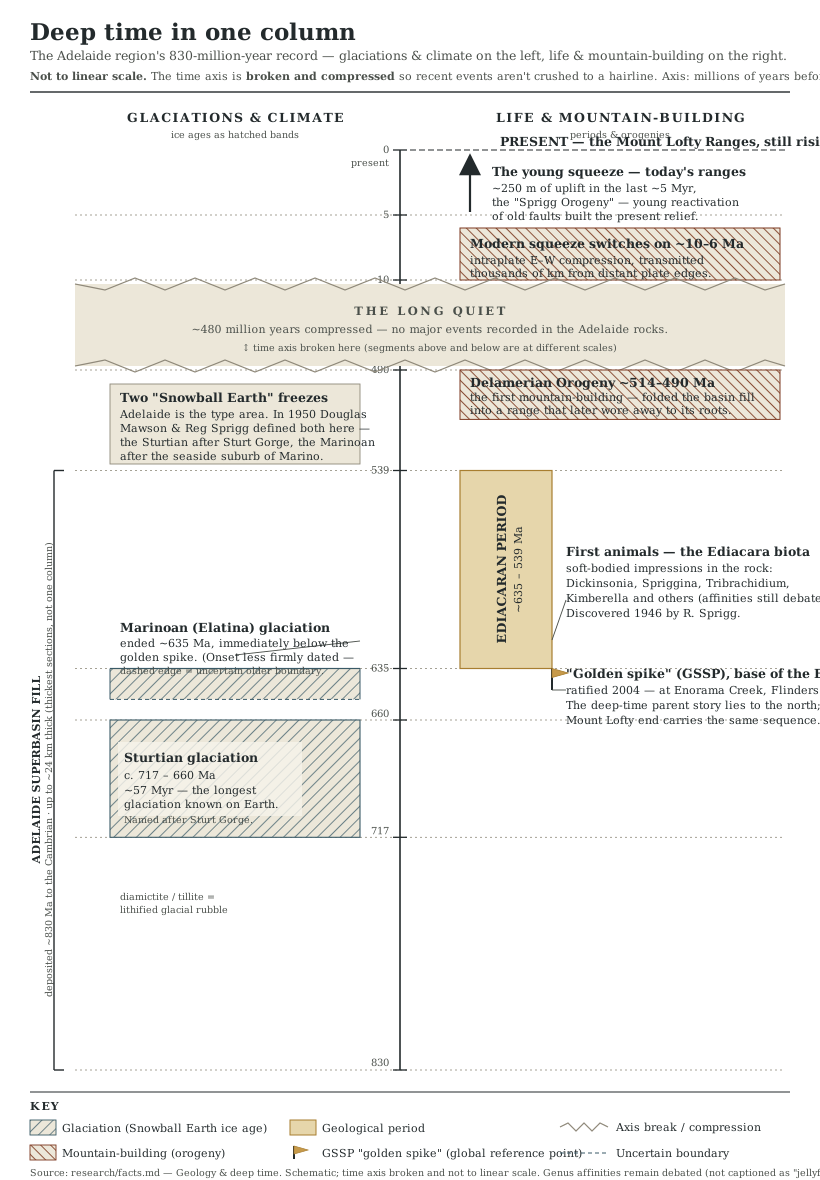
The Adelaide Rift and the Ediacaran dawn of animal life in the rock behind the city.
Chapter 3
The Land Steps Up
How a "stable" continent came to have an earthquake capital, and why the hills are still rising.
Chapter 4
From Rock to Soil
The thin, slow, living skin where the book turns from stone to life — and why Adelaide's came out sandy on top and salty below.
Act II · Chapters 5–7
The drought engine sets the rules
The Mediterranean bargain that gives Adelaide two seasons instead of four, the water a dry city has gone to great lengths to keep, and fire as the third force of summer — routine, not accident.
Chapter 5
The Mediterranean Bargain
Why Adelaide has two seasons instead of four, and the strange deal that climate strikes with life.
Chapter 6
Water in a Dry Land
How a city was founded on a creek that runs dry, and the lengths it has gone to since.
Chapter 7
Fire
The third force of the Adelaide summer — the one the land was built for, and the one we most fear.
Act III · Chapters 8–15
The living gradient demonstrates the rules
The longest act, and the demonstration rather than the tour: gulf to summit and down into the mallee behind, read the whole way as evidence for the rock and the drought that came before it.
Chapter 8
The Organising Idea
How to read a whole ecology as a single climb — a cross-section from the gulf to the summit.
Chapter 9
The Backwards Sea
Gulf St Vincent — a sea that gets saltier as you go into it, where the tide sometimes forgets to turn up.
Chapter 10
The Samphire Coast
The salt-soaked frontier where the gulf meets the land — and where a hemisphere's worth of birds comes to feed.
Chapter 11
The Vanished Plains and the Range Front
The richest country in the region, and the emptiest — and how to read what is no longer there.
Chapter 12
Stringybark Country
Into the Mount Lofty forests — a wet island of the past, marooned in a drying land, and quietly emptying.
Chapter 13
Gullies, Ferns and Swamps
The wettest corners of the ranges — where the refuge runs deepest, and the rarest things hold on.
Chapter 14
Behind the Ranges
Over the crest and out of the rain shadow — into the mallee, the dry scrub that farming could not quite kill.
Chapter 15
The Web of Partnerships
The invisible deals — pollination, seed-planting, dependency — that turn a list of species into an ecosystem, and what happens when they fray.
Act IV · Chapters 16–18
The great clearing, and caring for Country
Reading absence as detective work — a paddock, a street tree, a fence-line remnant, read for what it is the last trace of — then the environmental history that explains how so much vanished so fast, and what restoration looks like now.
Chapter 16
Reading Absence
The vanished animals, the losses we have stopped noticing, and the debts still being paid — how to see what is no longer there.
Chapter 17
An Environmental History
How, in under two centuries, a city remade its country — the fastest and most complete transformation in the book.
Chapter 18
Caring for Country Today
The turn from taking to keeping — restoration, rewilding, and the return of the oldest custodians.
Work in progress. The full first draft of all eighteen chapters — around 27,500 words — is complete. The manuscript is still being checked, chapter by chapter, against a canonical facts register before anything is called final, and it is not yet published or for sale.
Follow the writing
One email, when there's real news
No countdown, no sales pitch — just a note when a chapter reaches a real milestone, or when the book itself is ready to read.
Free. No spam. Unsubscribe any time.